Showing posts with label life-long learners. Show all posts

23 Nov 2016

What Neuroscience Tells Us About Making Fractions Stick

From the awesome MindShift blog, written by Katrina Schwartz:

https://ww2.kqed.org/mindshift/2016/11/21/what-neuroscience-can-tell-us-about-making-fractions-stick/


10 Nov 2016

Problem-based Learning - 'real life' in the classroom

Very cool programme - I'm thinking about how I might be able to do the same to make my maths programme more 'real' and more effectively teach skills alongside strategies and knowledge.

http://www.theedadvocate.org/mr-johnsons-classroom-fun/


21 Mar 2016

Modern learning - the role of teachers in the 21st Century

This week's video to contemplate, part of my course in the CORE MLP116 - challenging our beliefs about the role of teachers in today's education programmes.


23 Jul 2015

Coaching as a Leadership Tool

Yesterday I had the privilege to attend a workshop with educational consultant Trudy Francis, looking into the tool of coaching within a school context.

It was very useful, especially with my current roles of Associate Teacher for a third-year trainee, Literacy Lead Teacher running an Accelerating Literacy Learners programme, and a Deputy Principal overseeing an Effective Teaching Team.

I used the handout booklet Trudy gave us to record my notes, but here are my comments from my course report to the BOT:

Course Title: Coaching Leadership and Relationships – from skilful teacher to skilful coach
Course Leader: Trudy Francis  (C21 Learning consultant)  
Date: Wed 22nd July 2015          Location: Invercargill

Describe what the learning was about?
Workshop was focused on clarifying the coaching role and looking into effective methods for coaching within a school environment.
·        Coaching is about helping people succeed by developing their talents and transforming how people work together to achieve the aspirations and goals of their school community.
·        Coaching works best when the coached are empowered to make their own decisions with support, using predetermined goals for focus points.
·        Professional relationships must be built on/based on mutual trust and respect.
·        Coaches need to develop observation, listening and questioning skills – discussions with the ‘coachee’ involve active listening and exploratory questionning.
·        The GROW process aids the discussions between coach and coachee by ensuring the talking is focussed on the Goals, the current Reality, the Options available, and then What will happen next and When will it happen.

Professionalism: Teaching and Learning
What changes with/to your teaching will you implement as a result of your new learning?
·        The GROW process can easily be applied to pupil learning conversations – helping pupils to reflect on their current learning and discuss their next steps.
·        I can also use the GROW questions when working on my planning for any subject or group of pupils.

Professionalism: Conduct and Culture.
What implications does this have for your role in our school?
·        The GROW process is very much how I have already been carrying out my observations of my trainee teacher as well as observations of Jo and Wendy for the ALL programme, so running through it yesterday was a good reinforcement that I have been on the right track and gave me ideas on how to fine-tune my method and questioning skills.

·        Coaching can easily be carried out by any staff-member – it will be a natural step up from our Tony Burkin discussions about mind-growth and reflection/inquiry into our own teaching practices. I would like to apply it to our appraisal system – personal teaching goals especially – with teachers coaching each other (not necessarily just the ETT leader or curriculum leader doing it – actually a triangulation of people was discussed eg the coachee, the coach and another neutral observer). Would make sense to try this in 2016 once staffing changes have taken place.

RESOURCES

1 Mar 2015

2015 - first episode of TAKE TWO NEWS

All about the Year Six Welcome evening, featuring Black Cap cricketer, Hamish Rutherford...this event is held to celebrate our Year Sixes as leaders of the school...


2015 TAKE TWO NEWS - The Year Six Welcome Evening from Edendale Primary School on Vimeo.

30 Jan 2015

Beginning of the year!

This year (and this week coming!) I plan to make use of these links that I have pinned on my Pinterest boards...mostly free downloads from Teachers Pay Teachers...
Link to image source

'All About Me' pupil info sheet - though I have had to twink and change the American spellings eg favorite into NZ's favourite etc - thanks Science Doodles at Teachers pay Teachers!

And some discussion points from this Hot Spot activity sheet thanks to Kristine from the Young Teacher Love blog.

We will be doing the "In Team Kahu we..." mural again, as I have a whole new team of pupils - let's set up our expectations right from the start!

'Parents' 3-2-1' question sheet - asking parents for info about their child - thanks LA Beach Teacher at TpT as well as asking them for their most appropriate contact information.

'Student Rights and Responsibilities' - gets everyone on the same page about the expectations in the classroom - thanks Angelia at TpT!

I always do What Kind of Teacher Do You Want? and so does Miss Freundlich, it works with any age-group and helps the pupils see that you are wanting to work with them as a team and will respect their opinions and needs.

And we look also at What a good pupil does, says, is and is not - here is Sarah's example.

We will build our own version of this Respect chart and also look at this How Big is My Problem chart.

I will be sharing a copy of Stephanie's poster of Glasser's What We Learn chart.

Star of the Week certificate -  I've ordered this, printed with Team Kahu in the title - thanks Creative Classrooms!

'Uh-oh!' - a note pupils can take home with any work that they need to finish because they didn't do it during their allocated class time - thanks Sally at TpT!

Attention grabbers - you call out, the pupils respond - thanks Traci at TpT! I will be adding "To infinity..." (pupils call out "and beyond!") - sound familiar??

Link to image source
When talking about our learning and skills progression, I will share this Assess Yourself Novice-Expert chart and I also love this Which Step Have You Reached Today chart posted on a Lifetime of Wisdom.

We will also be referring to this Positive Self-Talking chart as shared by Elliott Seif.

For group work and partner discussions I will have these on display, as shown here by Tanja:
Partners  and   Groups

19 Jan 2015

Passion Projects as a LIteracy Programme

I've been devising a change for my literacy programme for my Year Six class - I don't know why I do this... well, actually, I DO know (it's because I am always trying to fine-tune my class programme to give the pupils the very best possible learning experiences...) but I have come up with (to quote Blackadder) "a cunning plan" to incorporate reading and writing by using the Passion Projects idea in a different way, one that will suit the way I operate...I'll try it out and see how it goes at least!

You can read my overview of intentions and term overview of topics here: click this link!

Basically, the plan is that at the start of the term I will offer up five different topics for literacy sessions - pupils will indicate which topic they are most interested in.  Guided groups will be developed from that, and I intend to incorporate relevant writing tasks alongside the reading tasks eg read an article about animal cruelty, write a letter to the SPCA commending them for their work - pupils may come up with ideas for writing as the unit progresses too (I want them to be guiding the direction of some of their tasks too...)

I need to have some aspect of control over the topics offered to the pupils as if I want to stay sane while building up the resources and lessons for four or five different groups I will need to keep certain limits on what is offered, while still giving pupils choices).  I have broken down some different topics into four terms - topics that twenty years of experience has shown are popular with pupils, while also trying to use topics that have relevant application to their world in 2015 and to have topics that will provide a good range of reading materials and writing contexts.

I have also aimed to cover a range of curriculum areas, with the topics being based on non-fictional themes, but choosing topics for which I will easily be able to find and incorporate fiction texts (ie in School Journal) that fit the theme as well, for instance in the unit about team sports we might read a narrative story about sportsmanship. I have also thought about topical events eg the 100th anniversary of Gallipoli and the Rugby World Cup.

I have thought of a range of EOTC experiences for the pupils to take part in at the end of their unit as incentives for completing a great range of tasks during the term. I have a goal to involve more parents, whanau (family) or community members as part of my class programme, so to have a couple of parents take a group of pupils for a morning fishing or to visit an exhibit at the aircraft museum, will be a good way to increase those connections.

For each unit, once I know which pupils are in that group, I will select the most relevant reading and writing learning outcomes to address, based on pupils' ability and next learning steps - these will be presented to the pupils for their comments and reflections on progress.

Wish me luck! I am off to start building up a class blog-post of online resources for each of Term One's topic units, as well as a Google Drive page for each unit (where the pupils of that group can look to find their independent task list, and I hope to also use the Google Drive for collaborated reflections and other shared tasks for each group/unit).

18 Jul 2014

HEALTH - Firewise - Fire safety practices

For the first week of Term Three our school health safety focus is Firewise - very important with so many homes using fireplaces at this time of the year!

The NZ Fire Service Firewise programme is aimed mainly at Years 1-2 but the resources can be adapted for older pupils, with a DVD available for Years 7-8 (and some parts can be used with Yr 5-6 with careful consideration).

With my Yr 6 pupils our focus will be on revising the basics about fire safety eg keep matches out of reach, the heater-metre rule, don't play near barbecues or fires; with the main focus being on Get Down...Get Low...Get Out Fast! (and Stay Out) and having an at-home escape plan and safe family meeting place.

For our literacy sessions this week, I plan to pair the pupils up to research and present one aspect of fire safety advice, using the Firewise booklets that the Fire Service has sent us (again, these are aimed at younger pupils but my older pupils will benefit too from having the messages reinforced). We will set a criteria together first so pupils have clear guidelines of what to share.

Pupils will create a presentation of their choice on the ipad to share on their blogs and on our class blog.


INQUIRY - Technology Production and Process


Term Three 2014 - TECHNOLOGY: 

PRODUCTION AND PROCESS  

Inquiry Question: MADE IN NZ!
How do we get ........?........ 
and why is it important 
to my life?

Key Understandings:
·         Technology is a man-made process.
·         Technology takes something that is natural and processes it into a product.
·         Technology makes life easier and provides more choice.
·         Technology provides greater convenience for daily living or job performance.

Core Knowledge:
·         Something natural becomes processed as soon as an aspect of it is changed by humans.
·         Processed items often don’t look like they originally were.
·         Some products are highly-processed, others are lightly processed.
·         The process of production can be shown by a flow-chart.
·         Technology involves inputs, outputs and controls.

http://technology.tki.org.nz
Key Competency:
Me as a COLLABORATOR

Key Strategy/Skill:
Thinking/Reflecting            

Key Value: Innovation

Focus: for pupils to create their own flow-chart (using Explain Everything app) of the production process of a product that is important in their life (which could be one of the products we investigate as a class, or a product that the pupil has chosen to investigate for themselves).

Assessment: (Level Three): 
Knowledge: Identify the steps and use appropriate language
to explain the process when producing a product.
Skill: Reflecting: Discusses and analyses, in discussions and
reflection logs, what he/she has learnt
and why it is important.

STAGES ONE-FIVE: EXCITING INFORMATION - DECIDING ON QUESTIONS - EMERGING IDEAS - NOW I'M SORTING - DISPLAYING MY IDEAS
http://www.redband.co.nz/
As a schol we share the same inquiry objectives but each teacher has flexibility to choose their own context to follow this, according to the needs and interests of the pupils in their class.

I have given the inquiry a ' Made in NZ!' focus to get the children to look at and appreciate the innovation that has occurred in our very own country where we as a people are known for our 'number 8 wire' thinking!

I intend to start the inquiry with a whole class investigation into Redband gumboots - almost every rural household in NZ will have at least one pair, if not multiple pairs of Redbands - a true Kiwi icon!

 (Gumboots = 'Wellingtons' in some countries)

The Redband website has a plethora of fantastic information about the history of the brand, and the manufacturing of the product!

It is a familiar product for my pupils and has a full and interesting production process, beginning with the harvest of the rubber and ending with the promotion of the product. I think they will enjoy finding how it all happens...

fibreglass innovations
After working as a class on the gumboots, I intend to take the children a little wider in their thinking by investigating the production and processes involved in a very modern product...fibreglass.

Local Invercargill firm Fibreglass Innovations makes a huge range of products with fibreglass, from lining swimming pools, to car parts, boats, all manner of items! They really  - I am hoping to make a visit there to see and discuss the process...

I might try to combine the trip with a visit to a clothing manufacturer - I have discovered Stormline Gear --NZ is an Invercargill-based firm that produces another product that will be familiar to many of the farming pupils.

Here is the video the company has made to share some insights into their products. I think it will be good for the pupils to view to learn about why materials have been chosen and how the product has been adapted to suit different purposes.


STAGES SEVEN-NINE: ASKING FURTHER - LET'S ACT! - EVALUATE IT ALL 


8 Jul 2014

Updating the pupils' mihi (personal introductions in te reo Maori)

I am updating my learning partnership book (homework books) folder and thought it would be a good chance to review the pupil mihimihi which they use when they introduce themselves at the start of our weekly celebration time. Time for a bit of research as I have about three different versions in my folder, which all have slightly different spellings or words...

Looking at the Korero Maori website I found this advice...

Mihimihi are introductory speeches which take place at the beginning of a gathering after the more formal pōwhiri. Mihimihi are generally in te reo Māori and can be given by females and males.
Mihimihi establish links with other people present. Mihimihi involve individuals standing to introduce themselves by sharing their whakapapa (genealogy, ancestral ties) and other relevant information. It is important for Māori to know and to share their whakapapa - to know one’s whakapapa is to know one’s identity.
Mihimihi can vary in length depending on the reason for the gathering, how well the individuals at the hui know each other and their links to one another.
A person will usually identify specific geographical features associated with their tribal area including their maunga (mountain), awa (river) and moana (sea). They may also identify their waka (ancestral canoe), hapū (sub tribe), iwi (tribe), marae and an eponymous ancestor. This information is considered more important than the individual’s own name which may be the last piece of information given in mihimihi.
maori.org.nz
The website gives an example of a typical mihimihi - only a couple of my pupils this year have Maori ancestry but they would be most welcome to use the more relevant waka, hapu, rangatira and marae references if they wish to.

Also consulting the Ministry of Education teacher book "He Reo Tupu, He Reo Ora" I have taken the website and book spellings as 'law' and I have created this mihi for our pupils to use in their learning partnership books to practise at home, based on the model they have previously been using, as well as this version for them to personalise with illustrations for their classroom book:

MY MIHIMIHI – a simple version for beginners…

Tēnā koutou!

(optional)  Ko _________________ te waka.          (ancestral canoe)

Ko _________________ te maunga.                       (mountain)
Ko _________________ te awa.                             (river)
Ko _________________ te iwi.                               (tribe/family name)
Ko _________________ taku matua.                       (father)
Ko _________________ taku whaea.                      (mother)
Ko _________________ au.                                   (my name)


Tēnā koutou, tēnā koutou, tēnā koutou katoa!


25 May 2014

Science inquiry - Why is Planet Earth the best place for me to live?

This term's school-wide inquiry is a Science them of outer space....

Our key understandings:
* The earth is the ideal place to live because it has water, atmosphere, food, gravity, animal live and the right temperature. 
* The sun is vital to our existence as it gives us light and heat. 
* The moon affects the earth. 
* Space is vast and made up of many galaxies.

The core knowledge:
* The earth is ideally located from the sun to have a temperature range that supports all kinds of life. 
* The sun gives light and heat. 
* Planets and moons rotate and orbit around the sun or their planet. (Rotation produces day and night. Orbit produces years.) 
* There are different types of astronomical bodies e.g. stars, comets, asteroids, planets, protoplanets, moons. 
* Each planet has a unique gravity, atmosphere, surface and composition.


Due to a combination of many factors (a nine-week term, a senior production happening in Week 3, my student teacher being on posting with 8 days of control in Weeks 4-6, and speeches happening before the end of term) I have broken the inquiry into three sections:
  • Weeks 1-3 (mainly 1-2 due to rehearsals for the show) are our exploration weeks, running on a Star Trekking theme - 
  • Week 1: the children contributed their first thoughts about the inquiry question to a padlet.com page and then, during reading time, the pupils used the links on a class blog post to find out about one of the planets:  Week One: classroom/student blog post - Star Trekking mission #1
  • Week 2-3: they can use the links on this blog post - Star Trekking mission #2 - to find out about other celestial bodies in our universe, whichever they were interested in.  We had first completed a group brainstorm of space-related words.  I have also given a list of the main words to our ESOL pupils so they can bring in their home-language words for the word-wall.
My  student teacher began a Social Sciences inquiry based on celebrations last term and will continue this in Weeks 4-6, coinciding her inquiry activities with the Maori New Year celebrations "Matariki" (the late May/early June appearance of the Pleides above the southern horizon) so this fits really well with our science theme.

In Week 7 the children will use the information they have learned to write a speech about any aspect of the topic (if they choose to) and for Weeks8-9 I plan to have a few HOT activities eg questions to debate, such as 'If we had to leave Earth, where would we go and what would we need to have?'  or "Which is more important - sunshine or water?"
 
Some other bits and pieces I have found along the way...

A great introductory/motivational video:


A cool video with examples of how to show the proportions of the planets and sun etc with everyday objects:

2 May 2014

2014: Inquiry: Being a life-long learner

Term One 2014 - INQUIRY - How can I be a life-long learner?
The wall display at the end of the term - most activities were digital and are on the pupil blogs.
Reason for this inquiry: 
* We have a new school logo, slightly changed motto and vision statement.
* The logo has children with backpacks – in these backpacks they put their learning tools: we need to introduce these images and concepts and help the children embrace them as their own philosophy.

HOST CURRICULUM: HEALTH - target curriculum level: Three (Year Six pupils)

Understandings: (Big Ideas/Key Concepts) 
  • I am unique; so is everyone else. 
  • I have different strengths that complement the strengths of others. 
  • Making healthy choices helps my learning. 
  • Great learning happens in partnership. 
  • I am responsible for my own learning.
Core Knowledge: (Baseline knowledge)
  • We can create our own toolkit for learning: SMARTS, turn-ons/turn-offs,school vision/motto/quotes/values; personal learning goals, making healthy choices (relationships, attitude, food, exercise, hygiene, sleep), working in partnership with others.
Inquiry Skill: Thinking      Key Competency: Managing myself      Value: Self-responsibility
Strategy: Six Thinking Hats         Blended Learning Opportunities: blogging, photos, tagxedo etc

Some of the concepts: motto, vision, competencies, backpack (toolkit) for learning
And, following our EDENDALE inquiry process, there was a huge range of possible learning activities...

EXCITING NEW KNOWLEDGE
(Covering the information in the core knowledge to build up a base of understanding to help pupils learn the Big Ideas.)

Attitude - having an attitude that is positive and healthy is important:
What the competencies mean for us...
We carried out a variety of discussions and activities to reinforce the key understandings, and found that our Year Six Camp was the most relevant activity of the whole term for pupils to be able to put the concepts into action!
Showing we were lifelong learners with our activities at camp...
Pupils used the experience for a variety of follow-up activities - writing about their demonstration of the aspects needed to be a lifelong learner - many of these were expressed with digital tools...


Year Six Camp from Edendale Primary School on Vimeo.


Take Two News 2014 - Year Six Camp from Edendale Primary School on Vimeo.

2 Apr 2014

Using the SAMR model with ICT devices in the classroom

I currently have 10 ipads in the classroom; all are set up through a classroom Google account.  This allows automatic/passworded access to:
  • our blogs
  • gmail - we can email many of our app creations
  • the itunes store/icloud storage (controlled by teacher via a separate password)

Our ipads are used individually, in pairs, or in groups of 3 (video projects only)
And are used for: writing, maths, reading, inquiry and for general exploring!


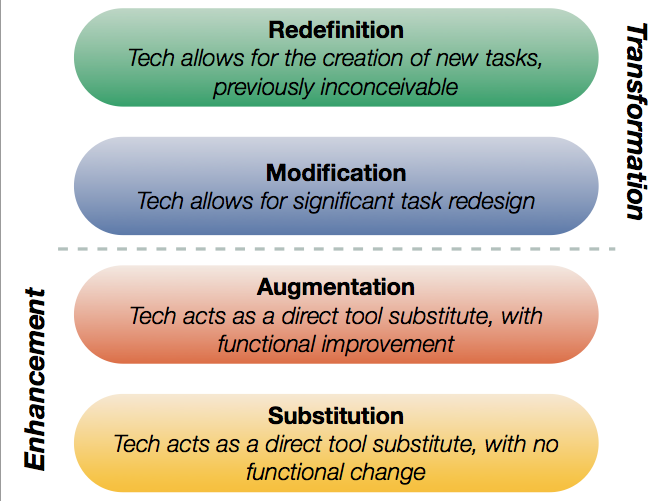
When planning activities or selecting apps for the ipads I try to keep in mind the SAMR model for technology tool use in the classroom (aiming for transformation activities where-ever possible:


SAMR_model.png


Image created by Dr. Ruben Puentedura, Ph.D        http://www.hippasus.com/rrpweblog/


APPS WE LOVE TO USE ON OUR CLASS iPADS:
  • SUBSTITUTION - iBooks, Vimeo, Google Maps, Wonderopolis, WWF Together, Number Line,Weird But True (Nat.Geog), Touch‘n’Slide Calculator, Math Slide (Add/Sub etc), Tap Quiz Maps, Safari (for reading websites/searching for info)


  • AUGMENTATION - Blogger, Comic Life, Wonderopolis, Typing Game, Google Earth, Kura, Piano, Maestro, padlet.com (used via Safari), Kibo 360, Let’s Get Inventing, Toon FX, PhotoBooth, and many MANY maths/spelling apps!


  • MODIFICATION - Shadow Puppet, Tellagami, My Story, Show Me, Puppet Pals, Sock Puppets, Comics Head, Friendstrip


  • REDEFINITION - iMovie, Explain Everything, GarageBand
Some links I have found interesting/useful as I consider how best to incorporate ICT tools such as laptops, digital cameras and ipads in my classroom programme.  I want the pupils to be getting maximum benefit from their use of these devices and the SAMR model keeps this in focus for me...

The SAMR model as applied to the use of a wiki - good visual example

Chart with simple explanation


14 Mar 2014

How the Brain Works

'Five Minute Film Festival'  from the Edutopia blog is a cool posting that shares videos of how the brain works/how students learn - perhaps more for teachers or parents or teenagers than for my Year Sixes though, but very interesting!


9 Feb 2014

LEARNZ Virtual Field Trip - Feb 2014 - Geohazards

A resource I love to use to provide content and extend my pupils for reading and/or inquiry, is the NZ website LEARNZ, which provides real-time virtual field trips to various locations or based on various events around NZ.

I love it because the field trips, once you have registered and they have taken place, can be accessed any time - so if it doesn't suit my programme to follow the trip in real time on the dates the trip takes place, my pupils can still make use of the related resources at another time - for instance in 2012 there was a wetlands field trip which we used about two terms later in the year when it fit better in support of our inquiry.

Term One of 2014 - 25-27 Feb - a field trip to the geo-thermal region of the Bay of Plenty in the North Island of New Zealand is taking place. We will be using it for our reading programme as I think the non-fiction nature of the content will really motivate my boys and my reluctant readers:
                

The topic of natural disasters is one that many children find fascinating and, as I cannot physically take my southern class to view this North Island area, they will be able to see it via the photos and videos that will take place on the website. They know this is our theme and were excited about what they might find out.

This is a link to the learning resources page I created on our classroom blog for the children to use: 

My guided group lessons will be using material based on the geohazard topics also, and the class bookshelf also has library books about the topics.  Different reading groups, as per ability, will be given guided or independent activities to complete over the next four weeks, some from the field trip and others based on their guided reading material.  These are the independent sheets that I have developed based on the fact sheets in the LEARNZ website.

Supporting materials - guided reading resources: to be used with various groups according to reading ability and interest level of the content...I usually set pre and post tasks for the title, meaning that the group has at least three days of activities with the guided text and one day of an independent activity using other resources (but that is a whole other blog post!)
  • Connected 2 2005 - Living on a Lava Flow
  • Connected 1 2011 - Ruaumoko Rages; Taupo; Time Capsules; Understanding Volcanoes; Living With a Volcano
  • School Journal Part 2 No. 2 2002 -  Make a Volcano
  • National Geographic Kids Science Readers Level 2 - Volcanoes!
  • School Journal Level 3 Nov 2011 - One City, Two Earthquakes
  • School Journal Story Library Level 3 - Quake, Rattle and Roll
  • Connected 2 2000 - Jago Descends
  • MainSails 2 - The Volcano Awakes!
  • MainSails 2 - Tsunami!
  • School Journal Part 4 No 3 2004 - A Bit of a Bang
  • MacMillan Winners - Killer Quakes
  • Scholastic Connectors - Extreme Scientists


30 Jan 2014

True Grit - the key to success...

Watched this awesome TED talk from Angela Lee Duckworth today as a point of interest for our teacher only meeting in preparation for starting school on Monday...our heads were nodding in agreement throughout the whole talk...


By a quirk of fate, the same TED talk popped up in a blog article I have stumbled across this evening while looking for info about Project Based Learning...Vicki Davis shares her (secondary level) lessons/ideas for teaching pupils about true grit